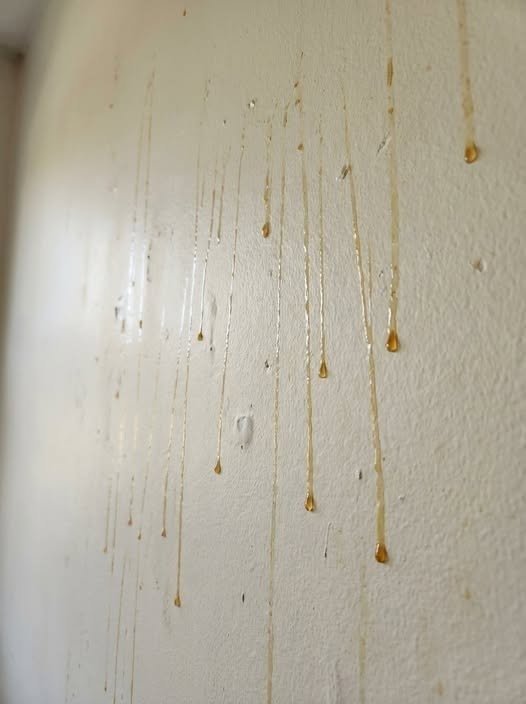
Yellow Drips on Bathroom & Bedroom Walls: Primary Causes & Removal Solutions
Finding sticky or oily yellow liquid dripping down interior walls—especially after a tenant moves out or in high-humidity areas like bathrooms—is a common problem. Even if the previous occupant did not smoke, several non-tobacco environmental and chemical factors cause this exact phenomenon.
1. Top Causes of Yellow Wall Streaks & Drips
1. Surfactant Leaching (Most Common Cause)
Latex and water-based acrylic paints contain surfactants—water-soluble additives that keep pigment smoothly suspended.
-
Mechanism: If paint dries in high humidity, cures at cool temperatures, or is exposed to hot steam from showers shortly after painting, surfactants migrate to the surface.
-
Appearance: Sticky, glossy, yellowish-brown or amber syrup-like droplets that streak down walls.
2. Aerosol & Product Condensation
Hairsprays, body sprays, air fresheners, and cleaning products leave invisible chemical residues on walls. When steam from hot showers condenses on cold walls, it dissolves these residues, creating yellow streaks as the moisture runs down.
3. Nicotine & Thirdhand Smoke Residue (Latent Leaching)
Even if the most recent tenant did not smoke, a previous occupant may have smoked inside. Nicotine and tar settle deep into drywall and underlying paint layers. When room humidity spikes, moisture penetrates the paint and draws old nicotine tar up to the surface.
4. Roof, Pipe, or Structural Water Leaks
Water leaking from overhead plumbing or roof insulation dissolves wood tannins, dust, and rust before seeping through drywall, creating dark yellow or brown water-stain streaks.
2. Diagnostics: How to Identify the Root Cause
| Cause | Sticky / Oily Texture? | Odor Profile | Typical Location |
| Surfactant Leaching | Very sticky / tacky | Mild soapy or sweet chemical smell | Bathrooms, newly painted rooms |
| Product Residue | Slightly tacky to smooth | Fragrant / cosmetic scent | Near vanities, showers, outlets |
| Thirdhand Smoke / Nicotine | Very sticky / dark amber | Stale tobacco / smoky odor | Rooms throughout the home |
| Water Leak / Tannins | Dry/chalky once evaporated | Musty / earthy odor | Near ceilings, exterior walls, pipes |
3. How to Clean & Prevent Yellow Wall Drips
Step 1: Deep Cleaning
-
Wash the walls with a mild solution of warm water and dish soap or a dilute Trisodium Phosphate (TSP) cleaner.
-
Use a soft sponge; avoid abrasive scrubbing pads that strip or scratch latex paint layers.
-
Rinse walls thoroughly with clean water and dry immediately with microfiber towels.
Note: If the issue is surfactant leaching, washing may need to be repeated 2–3 times over a few weeks until the excess surfactants are fully rinsed out.
Step 2: Sealing & Repainting (For Persistent Stains)
If cleaning does not resolve the issue—or if nicotine tar continues to bleed through:
-
Apply an Oil-Based or Shellac-Based Primer: Standard latex primers will not block water-soluble stains. Use a heavy-duty stain-blocking primer (e.g., Zinsser B-I-N Shellac-Base or KILZ Original Oil-Base).
-
Repaint with High-Moisture Paint: Apply $2\text{ coats}$ of premium interior paint with a satin or semi-gloss finish specifically rated for high-moisture/bath environments.
Step 3: Improve Room Ventilation
-
Run bathroom exhaust fans during and for $20\text{–}30\text{ minutes}$ after showers to keep relative humidity below $50\%$.
-
Allow newly painted rooms to cure for at least 7–14 days before exposing them to heavy steam or moisture.
For Complete Cooking STEPS Please Head On Over To Next Page Or Open button